
Today we’re taking a look at Task Force: Carrier Battles in the Pacific by Ginichiro Suzuki, published by Vuca Simulations. This game was originally published in the 80s and the designer is now deceased, so this is pretty much a straight reprint, but with a graphic design update, a real strong suit of Vuca.
It’s a heavy game, but I mean that literally. There are several maps, all but one of them mounted. And all the player aids and setup charts are mounted as well. The counters are pre-rounded, the type you individually punch out. Everything about the production values here are first rate.
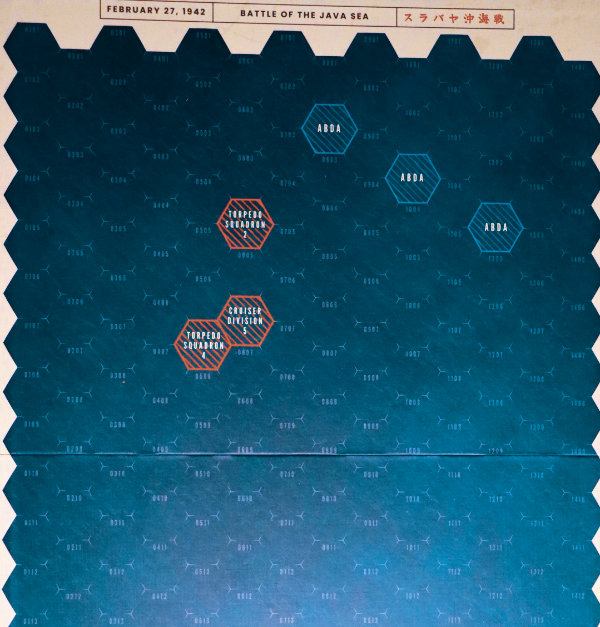 Detail: Java Sea scenario map
I think of this as a lighter version of another game that was reprinted this year, Pacific War. While Pacific War does have a big Strategic Scenario for playing out the whole war, as I understand it, Mark Herman’s design intention was more about the battles and smaller campaigns. Likewise, Task Force is all about battles. There’s no campaign here even if you wanted one. But there are ten scenarios. The first five are basically a programmed instruction method to teach you the game. The first, Pearl Harbor, teaches how to do an air attack vs ships. In the second scenario, you learn about naval movement and recon. The third teaches naval combat, and then the 4th teaches full on, carrier vs carrier, fleet vs fleet actions. Then we still have the non-teaching scenarios:
- Coral Sea
- Midway
- Eastern Solomons
- A hypothetical fleet vs fleet battle
- A fictional Indian Ocean raid
- Santa Cruz and Second Guadalcanal
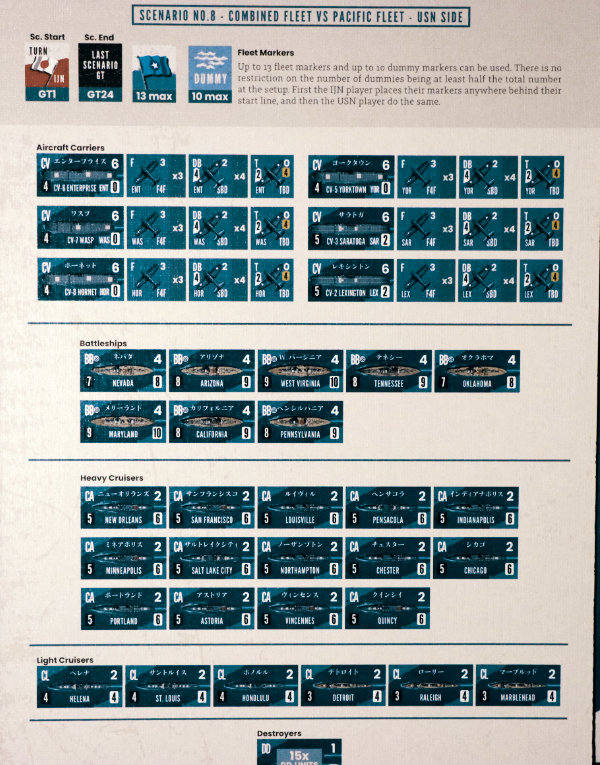 Scenario card example
So there’s a lot of play in here. Carriers and all capital ships down to Light Cruisers have their own named counters. Destroyers and transports are generic. Which sheds a bit of light on why the box is so heavy. Even ships that only appear in one battle are here.
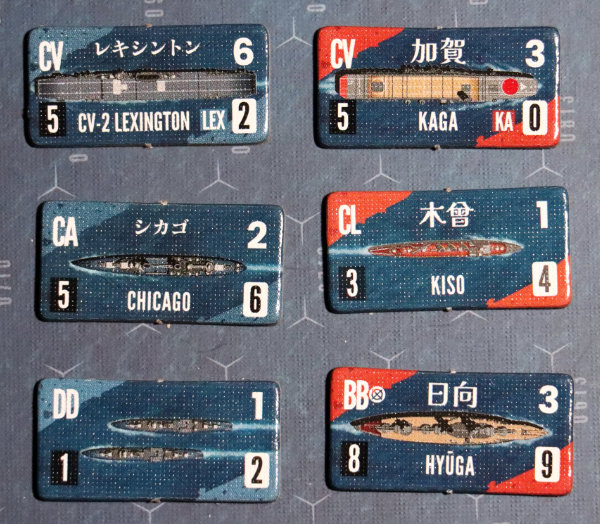 extreme closeup makes these counters look spotty- they aren't when you see them
So how does it all work? Mostly very simply. Ships have 3 ratings: Anti-Air, Naval Firepower, and Durability. They are all two-sided counters, so there is a damaged side as well with reduced ratings. Aircraft have an Air-to-air rating, as well as a range, and an air-to-surface rating for the divebombers and torpedo bombers. They also have a reduced side.
Combat is very simple. There are four combat tables: Anti-Air, Air-to-air, Air-to-surface, and Naval. They all work slightly differently from one another, but the genius thing is there is almost no die roll modifiers. Just a case of adding up the attack factors and roll on the charts. When fighting vs air units, the charts will tell you if you managed to deliver 0,1, or 2 steps of damage, and whether the air unit can continue on in the case of bombers.
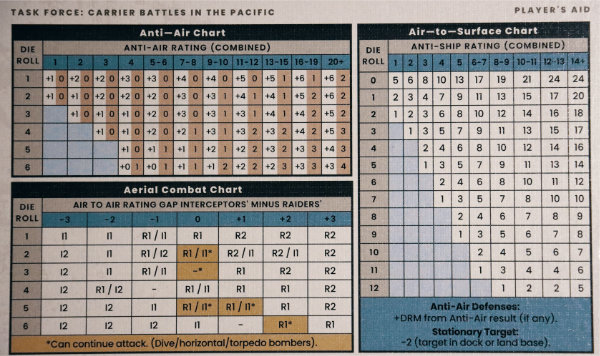
Naval hits are a little different. Each ship has a durability rating on its front and back. Destroyers are a 1, while battleships are in the 7-9 range. When attacking ships, you’ll generate a number of hits. If that number is less than the durability rating, no damage is done. If it’s equal to the rating, the ship suffers minor damage and is marked with a counter and rolls on a side table to see if the flight deck is damaged if it’s a carrier. If the ship takes it’s durability +1 in hits, the ship is flipped to its damaged side. If there are still more hits to assign, a similar process is followed. Under the durability number does nothing more. Equal to the durability number causes a critical hit. And over the durability number sinks her. Really straight forward, easy to understand.
But that’s getting ahead of things. How do we even get into combat?
Each side has a taskforce display board (again, mounted) with room for up to 13 task forces, 6 of them carriers. Carrier tfs can only have one carrier and up to 4 escorting ships. The game has been criticized a bit for this. However, you can place two tf counters on the map in the same hex, so you can still create larger forces. The non-carrier tfs can have up to nine ships. The ship counters go on the task force displays, not on the mapboard. The only thing on the map are the taskforce counters. Each side also gets a set number of dummy task force markers, dependent on the scenario being played. Beginners play with the task force displays out and visible to both players, but the game is much more nerve-wracking when each player keeps their display hidden.
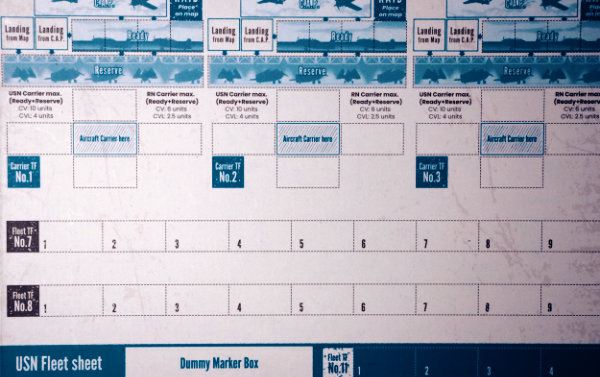 Only one carrier per taskforce. Some players have house-ruled this for multiicarrier TFs
Night turns are 3 hours long giving us 2 night turns per day, then day turns are 90 minutes long, giving us 8 day turns. Each turn starts with movement phase. Before movement, if two or move tfs are in the same hex, then can shift ships between them or combine into a single tf. Similarly, a single tf may split into two. Task forces can move two hexes in night turns and 1 hex in day turns. Who goes first alternates from turn to turn. Of course, dummy tfs are also moved. You can’t move into a hex containing an enemy tf, even if you suspect it’s a dummy. Your dummies can’t move adj to enemy tfs. After both players have moved, and dummies that are adj to a tf are removed.
If any real taskforces are adjacent to each other, they are revealed, and naval combat is initiated. There’s a simple process to determine range (which determines which ships will be able to participate), and then the simple combat roll for each attack.
If carriers or landbased air is in the scenario, it’s then time for the Aircraft Operations phase. Rather than alternating who goes first each turn, in this phase players roll to see who goes first. Each carrier of base with have a selection of fighters, divebombers and torpedo bombers. AIrcraft are always in one of 5 states: Reserve, ready, CAP (combat air patrol),raid, or landing. At the start of a scenario, all air units are in reserve. In the Air Ops phase, you can move reserve units to ready, ready units to cap or raid, and landing units back to reserve (or ready if they were landing from CAP). While a carrier may have 6 or more air units, only 4 can be in the ready box at any time. So we see that managing your flight deck becomes a big part of the game. Which types of units to have at the ready as well as how many fighters to send as escorts on raids vs how many to place on CAP.
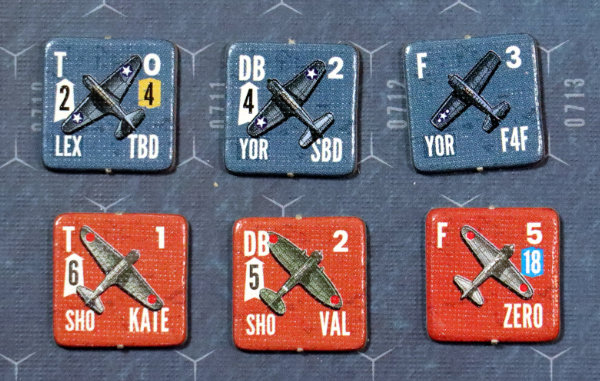
Any air units sent to raid are placed on map on the task force or base they are raiding. Once each play has done their assignments, the raids are carried out. First any CAP gets to try intercept the raiders and their escorts. They have to attack the escorts first. Any raiders that get through then have to face any anti-air, whether from ships or ground. If any raiders remain that haven’t been turned back, they attack the surface targets. Again, each step is a roll on a chart with generally no drms. Then all surviving air units of both sides are returned to base, whether land or carrier.
Then comes the Recon Phase. This is how you discover which enemy task forces are real and which are dummies. For each Carrier or land base you have, you get one or two search opportunities. You will draw chits from a bag and place them face down on any tfs within eight hexes of your carrier or base. You do not look at the uinderside of the chits. Your opponent will do the same. The bag of chits is 52 counters with SEARCH written on top, and then the bottom says either Lost Contact, Detected, or Misdirect.
Once both players have placed their search chits, the owner of each taskforce looks at the underside of the chit. If the chit says Lost Contact, no info is revealed. If the chit was Detected, you must reveal it the tf is real or a dummy, and if real, whether it contains a carrier or not.
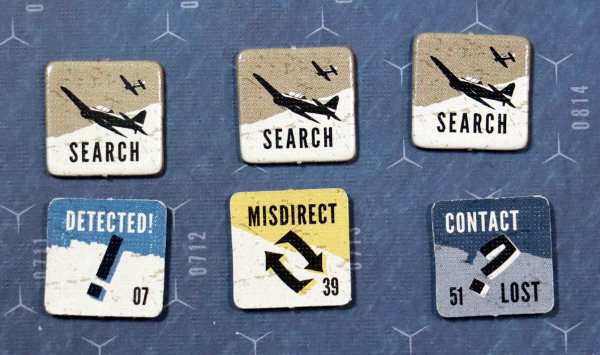
If the chit says Misdirect, you say Contact Lost if it’s a dummy. If it’s a carrier, you say Fleet sighted. If it’s a non-carrier group, you say Carrier sighted. You place the search chit under the task force chit to provide later verification. In this way, both sides forces are gradually revealed. Hexes can only be targeted for attack if the tf has been at least partially revealed, you can’t attack non-scouted task force markers.
Finally, there is an Admin Phase where you can repair a bit of light damage. And then it’s on to the next turn.
And that’s it. There’s a few other pieces of chrome: Full zero groups can be split into two reduced groups to try take on more enemies. B17s are exempt from anti-air. The Yamato, the biggest battleship on the water has special attack capabilities. A few other things.
All in all, I found this an easy game to get into. I zipped through the first 4 learning scenarios in a couple evenings and then was ready to play Coral Sea. Terrific fun. And with such straightforward tables I never felt I was missing a drm or rules exception. If you want to play some naval battles but GMT’s Pacific War seems too daunting, this is the game for you.
It does have a good-looking VASSAL module with all the scenarios included. However, it was a bit disappointing to see that although the map and the scenario cards are there, you still have to drag out all the counters. It would have been much better to have the counters out and ready to go. After all, scenarios in a module are basically just a save game file.

Vuca games are beautiful. This is my third game from them and each time I’m blown away. While I don’t knock a game for poor art design (the game play's the thing for me), that doesn’t keep me from appreciating exceptional components. But it does come at a cost. To buy, it costs $111 USD, plus shipping. It’s only $15 euros to the US. I’m in Canada and it’s $30 euros to me, so that’s a bummer. For comparison, you can order 1812 War on the Great Lakes Frontier from Compass. That game costs $99 but shipping to me was $46 USD, (so much more than #30 Euros). Compass’s US shipping is only $2 cheaper than Vuca’s, and Vuca’s games are coming from Germany. All that to say: don’t let Vuca being overseas put you off if you’re in the US. It’s right in the compass ballpark.
You can get a better look at the components by checkout out my unboxing video.


Add comment